UN says record numbers of people could face acute hunger if conflict continues

www.theguardian.com
The world has become well versed in the importance of the strait of Hormuz to the world’s energy flows, but attention is increasingly turning to its vital role in another market – the fertiliser on which harvests depend.
A third of the global trade in raw materials for fertiliser passes through the maritime choke point, which is also the route for 20% of shipments of natural gas, which is required to make it.
The waterway’s near-total shipping blockade is a “food security timebomb”, the head of the International Rescue Committee, David Miliband, said this week, adding: “The window to avert a massive global hunger crisis is rapidly closing.”
“Fertilisers are the No 1 issue of concern today,” according to the World Trade Organization, while the UN World Food Programme says the total number of people facing acute levels of hunger could hit record numbers this year if the destabilising conflict continues.
[...]
Roughly half of global food production depends on synthetic nitrogen fertiliser. Without it, crop yields would tumble, pushing up prices of household staples including bread, rice, potatoes and pasta, and would also make animal feed more expensive. Some of the world’s poorest countries are among the most vulnerable to fertiliser price rises.
[...]
The impact of the fertiliser price increases for different nations is partly dependent on their reliance on fertilisers imported from the Gulf, as well as the timing of the conflict in relation to the agricultural cycle.
While many European and North American farmers had already bought most of the fertiliser required for the imminent spring planting season, the timing of the latest fertiliser price rises is putting particular pressure on large importers, including Australia, where the majority of fertiliser shipments arrive between April and June.
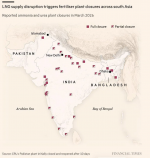
There are also growing worries about the impact of extended shipping disruption on India, the world’s second-largest user of fertiliser after China, where the sowing season for major crops including rice and wheat is approaching. India depends on imports of the raw materials to produce fertiliser, such as liquefied natural gas, as well as the finished product.
While the Indian government subsidises fertiliser for the nation’s food producers, any disruption to supply could reduce food production and push prices higher.
India’s less affluent neighbours, including Sri Lanka, Pakistan and Bangladesh, are almost all dependent on imports of Gulf fertiliser. African nations including Malawi, Tanzania, Uganda, Kenya and Sudan are also reliant.
The world’s least developed economies have the least capacity to absorb price shocks, and increased costs for fertiliser, fuel and food can quickly put pressure on household budgets and public finances.
[...]
Iran is losing every battle but winning the oil war. With the Strait of Hormuz closed, 20M barrels/day of oil have nowhere to go. Storage is filling. Wells are shutting in. The geological damage is permanent.

trendytechtribe.com
[...]
The timeline of destruction operates mechanically, governed by petroleum engineering and reservoir physics. The clock started ticking on March 4, 2026, when Protection and Indemnity clubs, the specialized mutual insurance syndicates that underwrite maritime liability, pulled war risk coverage for the Strait of Hormuz.
That single decision, made by actuaries in London and Oslo, accomplished what the entire Iranian Navy could not: it effectively closed the Strait. Lloyd’s List reported an 81% collapse in Hormuz transits within 48 hours. No insurance means no ships. No ships means 20 million barrels per day of crude oil with nowhere to go.
The sequence from there is governed by engineering, not diplomacy:
Days 1-14 (March 4-18): Tank farms at Fujairah (110+ million barrels of storage capacity), Ras Tanura, and other Gulf terminals began filling at $20 million barrels per day above their normal throughput rate. Operators started cutting production where possible, but Gulf wells operate under enormous geological pressure. You cannot simply dial them down like a faucet.
Days 14-30 (March 18 - early April): This is where the timeline stands now. Onshore storage is approaching capacity. Floating storage on anchored tankers provides a temporary buffer, but the economics are brutal: war-risk insurance premiums have surged to 1-3% of hull value per transit, and container carriers have imposed emergency surcharges of $2,000 per twenty-foot equivalent unit (TEU). Keeping crude on water is a losing financial proposition measured in millions of dollars per day.
Days 30-60 (April - late April): When storage hits 100%, producers face the nightmare scenario described in detail in this site’s earlier analysis. Wells must be shut in.
Days 60+ (May onward): Permanent geological damage begins accumulating at scale. This is the point of no return.
This is the section that should terrify anyone holding the assumption that this crisis will simply “resolve” and production will snap back to normal. It will not.
When a high-pressure oil well in the Persian Gulf is shut in, three simultaneous destructive processes begin inside the reservoir:
Paraffin wax crystallization: As temperature and pressure fluctuate during shut-in, heavy paraffin waxes dissolved in the crude oil begin to precipitate and crystallize. These wax crystals deposit inside the microscopic pore spaces of the reservoir rock and along the steel wellbore casing, physically plugging the pathways that oil flows through.
Asphaltene precipitation: Similar to paraffin, asphaltenes (the heaviest, most complex hydrocarbon molecules in crude oil) drop out of solution and form solid deposits. These molecules are notoriously difficult to remove, sometimes requiring chemical injection or complete wellbore workovers.
Water bypass: The most devastating mechanism. Gulf oil fields use natural water drive, where pressurized water beneath the oil column forces crude to the surface. During a shut-in, this water does not stop moving. It bypasses the oil, channeling through paths of least resistance and leaving massive pockets of crude permanently trapped in the rock matrix with no way to reach the wellbore.
This is not a power outage where you flip the switch and the lights come back on. This is structural destruction of the geological infrastructure. When operators attempt to restart these wells after weeks or months of being shut in, they will not get the same flow rate back. Ever.
Restoring a damaged well requires secondary recovery techniques: injecting steam, chemicals, or carbon dioxide to re-pressurize the formation and dissolve the wax and asphaltene blockages. This takes months. It costs billions. And it often recovers only a fraction of the original production rate.
[...]


 www.bbc.com